
Silver Jewelry Wholesale: Sampling at 25–30 Days
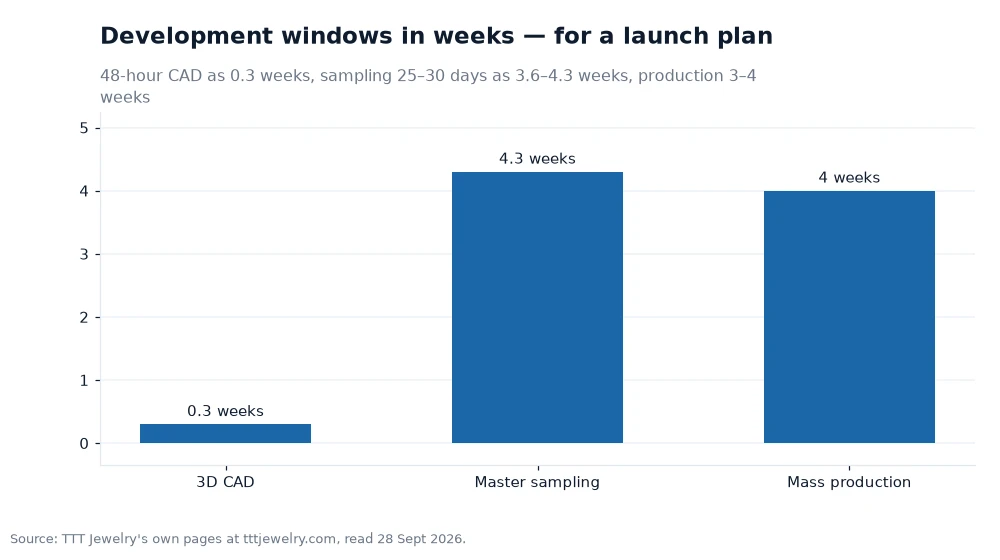
The number that decides a launch date is not the production window, it is the master sample. Published lead times put 3D CAD at under 48 hours, physical sampling at 25–30 days and mass production at 3–4 weeks after approval. Add them and a first silver order lands between roughly seven and nine weeks — with an MOQ of 50 pcs per design in 925 sterling silver as the barrier to entry.

Key takeaways
- CAD is quoted under 48 hours; the master sample takes 25–30 days; production runs 3–4 weeks after approval.
- Express the sampling window in weeks and it reads 3.6 to 4.3 — the same block that planning calendars usually round down.
- Sampling covers five named operations: 3D wax printing, mould casting, stone setting, polishing and electroplating.
- Floors are 100+ in stainless work, 100 in eco-brass and 50 pieces in the silver line, per design.
How to read the three published windows together
Each window answers a different question. The 48-hour CAD stage answers "what are we making", and it produces a dimensioned drawing plus a rendering for sign-off. The 25–30 day sampling stage answers "can it be made as drawn", and it ends with a physical piece you can hold. The 3–4 week production stage answers "can it be repeated", and it ends with inspected cartons.
Only two of the three can overlap with anything else, and only if the buyer is fast. CAD cannot start before the design brief arrives, and production cannot start before the sample is approved. Whatever your own approval time is, it is additive.
What happens during the 25–30 days
Five operations fill the window: 3D wax printing, precision mould casting, stone setting, polishing and custom electroplating. They are sequential, and the last two are the ones that cannot be rushed without the result showing. Polishing determines how the piece reads; electroplating determines its colour and, on silver, carries the anti-tarnish e-coating on top.
A supplier that quotes a sampling window shorter than three weeks is either re-using an existing mould or skipping a stage. Re-using a mould is a legitimate answer for a variant of an in-production design; skipping a stage shows up in the finished surface two months later.
On the silver page the same source publishes four details to quote back in an order confirmation: each piece stamped S925, a nickel-free and allergy-free alloy, eco-friendly electroplating applied on a 925 base, and a quality block covering ISO 9001:2015, BSCI and REACH. Sample testing runs before production, which is the mechanism that turns a 25–30 day sample into an approved reference for everything that follows.
Turning sampling days into a launch calendar
Work backwards from the date your stock has to be on a shelf. Take the shipping leg as a given, then add production at 21–28 days, then sampling at 25–30 days, then 2 days for CAD. A launch on the first of a month means the design brief has to be with the factory roughly nine weeks earlier, which is the point where most first orders are found to be late rather than slow.
If you need to compress, compress where it is cheap: approve the CAD drawing in a day rather than a week, and give feedback on the sample in one round rather than three. Those are the two waits a buyer controls, and together they can move the date by a fortnight.
Three answers to get before you order
A sterling silver jewelry supplier China brand buyers trust will put the three windows in writing, and will also say what happens if one slips. The published commitments are a 24-hour response time and a 1-on-1 dedicated project manager, which are the two mechanisms through which a slipped date is communicated rather than discovered.
Then ask what the sample covers. A sample produced with the final plating colour and the final stone is an answer about the product; a sample produced in a generic finish is an answer about the shape only. Specify the finish before the sample is ordered, because re-sampling consumes another 25–30 day block.
| Stage | Published window | Converted |
|---|---|---|
| 3D CAD modelling | Under 48 hours | About 0.3 weeks |
| Master physical sampling | 25–30 days | 3.6–4.3 weeks |
| Mass production | 3–4 weeks | 21–28 days |
| Sterling silver MOQ | 50 pcs per design | Per design, not per order |
| Rush response | 24-hour reply | Applies to enquiries and changes |
Worked example: the full runway in days
Sum the published blocks in their own units first. CAD: 48 hours. Sampling: 25 to 30 days. Production: 21 to 28 days. Adding the two day-blocks gives 25 + 21 = 46 days at the fast end and 30 + 28 = 58 days at the slow end.
Convert the 48 hours to two days, and the total becomes 48 to 60 days, or roughly seven to nine weeks. Expressed the other way: the CAD stage is 48 ÷ 720 = 6.7% of a 30-day sampling window and 48 ÷ 600 = 8% of a 25-day one — under a tenth of the sampling block, which is why arguing about CAD turnaround is rarely where the launch date is won. The window figures are published; the sums are mine.
Where the minimums land in a first purchase order
Each design carries its own minimum: 50 pieces in silver, 100 in artisan eco-brass, 100+ in stainless steel. An order is the sum of those, not an average. Three silver designs are 3 × 50 = 150 pieces before packaging is counted; the same three designs in brass would be 300.
Mixing materials inside one purchase order is normal, but the minimums do not offset each other. A brand with a precious hero piece and a lower-priced plated line should expect the silver minimum and the brass minimum to both apply, in full.
Where the delays actually come from
Ask a factory what usually pushes a date and the honest answer is the buyer's side, not the bench. A sample sits in a warehouse for a week waiting for someone to open the box; a CAD revision waits for a marketing team to agree on a stone size. None of that appears in the published windows, and all of it lands on the launch calendar.
The second source is a design that changes material after sampling. Switching a design from eco-brass to 925 sterling silver is not a finish change; it is a new mould, a new minimum of 50 pcs per design, and a new sampling cycle. Decide the metal in the brief, and the 25–30 day window stays a single pass.
The third is packaging, because a barcode label, a foil-stamped box and a backing card are produced on their own lead times. Get the packaging spec approved alongside the CAD drawing so it is ready when the pieces are.
Frequently asked questions
Why does the master sample take 25–30 days?
Because five operations run in sequence inside that window: 3D wax printing, mould casting, stone setting, polishing and custom electroplating, followed by a physical sample you inspect.
Can CAD work start before I have a finished design?
Yes. Rough drawings, reference photos or a used piece with change notes are accepted, and the technical drawing plus rendering comes back within 48 hours for dimensional approval.
How much buffer should I add to a launch date?
Plan on 48 hours for CAD, 25–30 days for sampling and 3–4 weeks for production, then add your own approval time at each gate — the total lands near seven to nine weeks.
Building the calendar before the collection
The order that goes wrong is rarely the one with the longest lead time; it is the one where nobody wrote the windows down. Put the three blocks in your own project plan, with a named owner for CAD approval and a named owner for sample feedback, and the supplier's 24-hour response has something to respond to.
If the range spans materials, read the eco-brass minimums before you size the plated line, and check the OEM and ODM routes to see which one your design brief fits before the first call.
The specification this article works from — the 24-hour reply commitment, followed by the eco-conscious electroplating, the ISO 9001:2015, BSCI and REACH statements — is published on the client's own website on tttjewelry.com, which I read through on 28 Sept 2026. The order-of-magnitude reading is my own arithmetic rather than the manufacturer's[1].